
Balancing AI efficiency with authentic storytelling to keep your brand voice strong.
Summary: Learn how to build your brand voice using AI without sounding robotic. Discover practical ways solopreneurs can use AI tools to save time while keeping content authentic and human.
Introduction
When I first started experimenting with AI writing tools, I’ll admit — I was skeptical. Could a machine really help me tell my story? As a solopreneur, I’ve always believed that my voice is the one thing no one else can copy. It’s the thread that ties my business together and builds trust with my audience.
And yet, here I am writing this article with AI’s help. Not in the way you might think — I don’t let AI “do the writing for me.” Instead, I use it the way I’d use a research assistant: to help organize ideas, refine outlines, or polish rough drafts. That balance is exactly how I’ve learned to build my brand voice using AI — keeping my message consistent, but never losing the human touch that makes it mine.
For solopreneurs, using AI in business can make day-to-day operations more efficient — but it should never come at the expense of what makes your brand personal.
That balance is the key to making AI work for small businesses. Because while AI can save you time, it can also strip away the personality that makes people want to work with you in the first place.
The Benefits (and the Limits) of AI
Let’s start with the obvious: AI is fast. It can draft three versions of a social caption in seconds, summarize customer reviews into themes, or help you brainstorm blog titles when you’re stuck. For a one-person business, that kind of speed levels the playing field. You don’t need a team of marketers to look polished online.
Tools like ChatGPT and other AI writing tools can generate headlines, summarize reviews, or repurpose old blog posts into new content — tasks that once ate up hours of a solopreneur’s day.
But speed has a shadow side. Research published in the Journal of Advertising looked at how people respond when content feels mismatched — for example, when a brand’s tone doesn’t align with the platform it’s on or the expectations of its audience. The study found that in those cases, people were less likely to trust or engage with the content. In other words, if your message feels generic or out of place, it can backfire.
Harvard Business Review, in their article “Branding in the Age of Social Media”, points out that while personalization can drive growth, most consumers don’t feel truly understood by the businesses marketing to them. That disconnect is the risk with AI. If you hand over the whole job, you end up with content that sounds polished but hollow.
How to Build Your Brand Voice Using AI While Staying Authentic
Protecting an authentic brand voice has become one of the biggest challenges in the age of AI. Customers crave personality, not polish, and they can tell the difference instantly.
If you’re unsure who you’re really speaking to, revisit your Customer Persona Blueprint: Understand Your Audience to stay grounded in what your audience values.
Here’s where things get real. People are skeptical of AI. They worry about losing the human connection, and honestly, they’re not wrong. Younger consumers especially want to know who’s behind the businesses they support. If your brand voice suddenly shifts into something robotic, trust can erode quickly.
Transparency goes a long way. Research shows that many consumers now expect disclosure when AI is part of the process. I think of it this way: my audience doesn’t need to know the details of every tool I use, but they do need to know that I’m still the one guiding the message.
That’s why I’m sharing this with you now. Yes, I use AI in writing these MBTH articles — and even for many of the images you see here. Beyond content, I’ve used ChatGPT to help troubleshoot website speed issues (which turned into the article From Slow to Speedy) and to plan out email sequences for marketing campaigns. These tools are great at taking the heavy lifting off my plate, but I never just copy and paste what they give me. Instead, I refine the output and add my perspective, so the final product reflects my experience and point of view.
And if you’re curious, many of these tools are simple enough to try yourself — even for things like creating graphics or planning your next campaign.
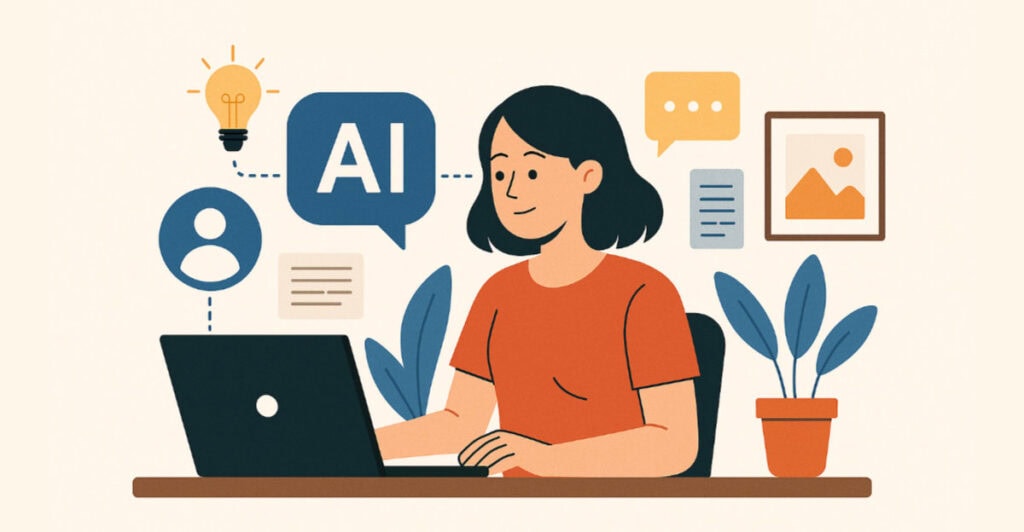
Making AI Your Partner, Not Your Replacement
Think of AI as a helpful sidekick. My process usually starts with me brainstorming a pile of thoughts — quick notes, fragments, even repeats — without worrying about grammar or polish. Once I’ve emptied my head, I bring ChatGPT in as an editor and organizer. It cleans up the messy draft, trims out repetition, and gives the content a clear structure and flow. It also helps me see when I’m getting wordy, drifting off-topic, or leaving out a good connection to another MBTH article that readers might find useful.
AI content creation works best when it starts with your ideas and ends with your perspective. The goal isn’t to replace your creativity but to refine it — the same mindset that applies to developing consistent marketing habits (see 5 Proven Marketing Strategies to Help Your Microbusiness Stand Out).
From there, I step back in and finish the work. I add personal examples from my own experience, reframe the tone so it fits MBTH’s style, and weave in the insights I’ve gained working with small businesses. That’s the part AI can’t do for me.
The lesson for solopreneurs is simple: let AI lighten the load, but don’t give it the wheel. Your customers aren’t looking for perfect grammar or keyword-stuffed paragraphs. They’re looking for a person they can trust.
Final Thoughts
AI for solopreneurs isn’t about replacing creativity — it’s about reclaiming time, simplifying the process, and keeping your focus where it counts: building relationships and trust.
AI is here to stay, and used well, it can be a powerful tool for solopreneurs. But tools don’t build trust — you do. Your voice, your story, and your perspective are what make people connect with your brand.
The businesses that will stand out in this new landscape aren’t the ones who publish the most AI-generated content. They’re the ones who use AI to free up time while doubling down on authenticity.
So if you’re worried about losing your voice, don’t be. Use AI as a partner, keep your hand on the pen, and remember: that’s how you truly build your brand voice using AI — not by replacing yourself, but by amplifying what makes your story unique.
Want to see more ways we’re using AI to simplify solopreneur life? Join our community for behind-the-scenes tools, tips, and insights that help you stay authentic while working smarter.